| Your Lifestyle |
Recommended Energy Level |
Daily Requirements |
Signs the Match Isn’t Right |
| Quiet lifestyle or long working hours |
Low |
Regular walks and light mental stimulation |
The dog struggles to settle down or becomes destructive |
| Moderately active |
Moderate |
Daily walks, playtime, and short training sessions |
You can’t maintain a consistent routine |
| Active every day |
High |
Varied exercise and mental enrichment |
You rely only on a quick daily walk |
| Athletic and enjoy outdoor activities |
Very High |
Multiple exercise sessions and structured training throughout the day |
Your active lifestyle is limited to weekends or holidays |
| Family shares the responsibility |
Moderate and Flexible |
A clear schedule for walking, training, and play |
No one is consistently responsible for the dog’s routine |
Do You Have Time to Train a Dog?
Training is one of the most important parts of responsible dog ownership. Before bringing a puppy home, ask yourself the following questions:
✓ I can set aside a few minutes every day for short, consistent training sessions.
✓ I can teach my dog basic commands, leash manners, house training, and good behavior.
✓ Everyone in my household will use the same commands and rules to avoid confusing the dog.
✓ I will rely on positive reinforcement, rewards, and encouragement rather than shouting or harsh punishment.
✓ If behavioral issues arise, I’m willing to work with a qualified dog trainer.
Is the Dog Suitable for Children?
Dogs can be wonderful family companions when you choose a breed with the right temperament, establish clear boundaries, and supervise every interaction. That’s why selecting the right dog shouldn’t be based solely on breed reputation.
Keep these important points in mind:
Choose a dog whose energy level and size are appropriate for your children’s ages. Teach children never to pull the dog’s ears or tail, disturb it while it’s sleeping or eating, or treat it roughly. Younger children require closer supervision because they may not recognize signs that a dog feels uncomfortable.
Ask about the dog’s previous experience with children and how it responds to loud noises, fast movements, and busy environments. Don’t rely only on a breed’s reputation. One dog may thrive in a family setting, while another of the same breed may find a busy household stressful.
Never leave a young child alone with a dog, no matter how calm or well-trained it seems. Supervise playtime, stop interactions if you notice signs of fear or stress, and teach children to give the dog space whenever it wants to rest.
Keep the first introductions short and positive. Reward calm behavior and provide the dog with a quiet area where children won’t disturb it. Proper preparation and consistent training help build a safe, trusting relationship between your dog and your family.
Can the Dog Live with Other Pets?
Many dogs can happily live with other pets, but compatibility depends on the dog’s personality, previous experiences, and the introduction process—not simply the breed.
If your home already has pets, consider the following:
Ask whether the dog has previously lived with cats or other dogs, and observe how it reacts to movement, unfamiliar sounds, and small animals. A dog that is friendly with people isn’t automatically comfortable around every animal.
Introduce pets gradually by allowing them to become familiar with each other’s scent before arranging supervised face-to-face meetings. Use a secure barrier at first, keep sessions short, reward calm behavior, and never force interactions before both animals feel comfortable.
Provide separate feeding areas, sleeping spaces, and resting places. If you have a cat, make sure it has access to elevated areas or safe rooms where it can retreat. If your home includes birds, rabbits, or other small pets, ensure they remain safely separated, as a dog’s prey drive may appear even in normally calm individuals.
Watch for signs such as chasing, staring, growling, hiding, or refusing food. These behaviors indicate that introductions should slow down. Never leave pets together unsupervised until you’re confident they have adjusted to one another. If tension continues, seek advice from a veterinarian or a qualified animal behaviorist.
Which Dog Breeds Are Best for First-Time Owners?
| Breed |
Best For |
Main Commitment |
May Not Be Suitable If… |
| Labrador Retriever |
Active families looking for an easy-to-train companion |
Daily exercise and portion control |
You don’t have time for exercise or don’t like shedding |
| Golden Retriever |
Families wanting a friendly, intelligent dog |
Regular activity and frequent brushing |
You’re looking for a low-maintenance breed |
| Poodle |
Apartment living and owners wanting a highly intelligent dog |
Mental stimulation and professional grooming |
You don’t want ongoing grooming expenses |
| Papillon |
People looking for a small, energetic indoor companion |
Mental games and consistent training |
You prefer a dog that’s calm all day |
| Whippet |
Owners who enjoy a quiet dog indoors |
Safe walks and controlled off-leash activity |
You have small pets that can’t be safely separated |
| English Springer Spaniel |
Active people who enjoy outdoor activities |
Daily exercise and regular brushing |
You’re away from home most of the day |
How Does the UAE Climate Affect Your Choice of Dog?
The UAE’s high temperatures and humidity have a major impact on a dog’s ability to breathe, exercise, and regulate body temperature. That’s why climate should be one of the key factors when choosing the right dog.
Not all breeds handle hot weather equally well. Flat-faced (brachycephalic) breeds, such as Pugs, French Bulldogs, and English Bulldogs, are more vulnerable to heat stress because their shortened airways make cooling themselves through panting less efficient. Older dogs, overweight dogs, and dogs with breathing problems are also at greater risk. Always consider a puppy’s health—not just its appearance or popularity.
Active dogs still need regular exercise, but the UAE’s climate limits safe outdoor activity during much of the day. Choose a breed whose exercise needs can be met through early morning or evening walks, training sessions, scent games, and indoor mental enrichment. Exercising in extreme heat is one of the leading causes of heatstroke.
Dogs living in the UAE need a well-ventilated, air-conditioned environment, constant access to fresh water, and shaded areas away from direct sunlight. Never leave a dog inside a parked car, even for a few minutes, and always check the temperature of sidewalks and roads before walking, as surfaces can become dangerously hot.
Heavy panting, excessive drooling, weakness, confusion, stumbling, or collapse are all warning signs of heatstroke. If you notice any of these symptoms, stop all activity immediately, move your dog to a cool place, and contact a veterinarian without delay.
Choosing a dog that can comfortably adapt to your lifestyle also means choosing one whose daily routine can be safely managed throughout the UAE’s hottest months.
Can You Handle Barking and Shedding?
Before choosing a dog, be honest about how comfortable you are with barking and shedding. These are normal parts of dog ownership, but they vary greatly from one breed to another.
Use the checklist below to evaluate your expectations:
✓ I understand that some level of barking is normal, and I’m prepared to manage it without shouting or using harsh punishment.
✓ I have the time to train my dog and identify the reason behind excessive barking, whether it’s boredom, fear, or a need for attention.
✓ I’m willing to clean my floors, furniture, and clothing regularly if my dog sheds.
✓ I can commit to brushing my dog’s coat according to its grooming needs and pay for professional grooming when necessary.
✓ I’ve considered whether my dog’s barking and shedding will be suitable for my family, neighbors, and living environment.
Puppy or Adult Dog: Which One Is Right for You?
| Decision Factor |
Puppy |
Adult Dog |
| Daily Time Required |
Needs constant supervision and frequent care |
Requires regular care but usually less supervision |
| Training |
Starts from scratch with house training, obedience, and socialization |
May already have basic training but could require habit adjustments |
| Personality |
Temperament and adult size are still developing |
Personality, energy level, and size are already established |
| Staying Home Alone |
Not suitable for long periods alone |
Often adapts more easily to a stable routine |
| Best for First-Time Owners |
Ideal if you have plenty of time and patience |
May be easier if you know the dog’s history and behavior |
| Best Choice If… |
You want to experience every stage of your dog’s development |
You prefer a dog whose personality is already easy to evaluate |
How Much Does It Cost to Own a Dog in the UAE?
Owning a dog is a long-term financial commitment. Besides the purchase price, you’ll need to budget for food, healthcare, grooming, supplies, and unexpected emergencies.
| Expense |
Estimated Cost |
Payment Frequency |
When Costs Increase |
| Food |
AED 150–600 |
Monthly |
Large breeds or prescription diets |
| Preventive Veterinary Care |
AED 500–1,500 |
Annually |
Additional tests, medications, or treatments |
| Grooming |
AED 150–350 |
Per session |
Long-coated or large breeds |
| Supplies and Toys |
AED 300–800 |
Initial setup |
Large beds, crates, or premium accessories |
| Dog Registration & Microchip (Dubai) |
Starting from AED 60 |
One-time registration |
Private clinics may charge more |
| Boarding During Travel |
AED 80–200 |
Per night |
Peak seasons or premium boarding services |
Common Health Problems by Breed
Every breed has its own potential health concerns. Understanding them before buying a puppy helps you make a more informed decision.
| Breed or Group |
Common Health Concerns |
What to Check Before Buying |
| Flat-faced breeds (Pugs, French Bulldogs, English Bulldogs) |
Breathing difficulties, eye conditions, skin fold infections |
Check breathing, nostrils, eyes, and the puppy’s ability to move without excessive panting |
| Large breeds (such as German Shepherds) |
Hip and elbow dysplasia |
Ask for certified hip and elbow screening results from both parents |
| Dachshunds |
Intervertebral Disc Disease (IVDD) and back problems |
Review spinal health and family medical history |
| Cavalier King Charles Spaniel |
Mitral valve disease |
Request heart examination results for both parents and check for early heart murmurs |
| Breeds prone to inherited eye diseases |
Progressive Retinal Atrophy (PRA), cataracts, and other genetic eye disorders |
Ask for certified eye examinations and recommended DNA health tests |
How to Choose the Right Dog for Your Family
Choosing the right family dog starts with understanding your household’s needs and comparing them with a breed’s personality and care requirements.
Here are the most important factors to consider:
Choose a dog known for having a balanced temperament and good trainability. Keep in mind that young children should always be supervised during interactions with dogs. Don’t rely solely on breed descriptions—evaluate the individual dog’s behavior, confidence, and comfort with handling and household activity.
If your family enjoys an active lifestyle and can commit to daily walks and playtime, a high-energy breed may be an excellent match. However, if your routine is quieter or everyone spends long hours away from home, look for a dog with lower exercise needs.
Don’t assume that a small dog automatically requires less work. Some small breeds are extremely energetic or vocal. Also consider whether the dog is likely to live peacefully with cats or other dogs, and always introduce pets gradually instead of expecting them to get along immediately.
Before making your decision, review the breed’s training requirements, grooming needs, nutritional costs, veterinary care, and common health concerns. Choose a dog your family can realistically care for throughout its entire life—not just during the excitement of bringing home a new puppy.
Which Dog Breed Matches Your Lifestyle?
| Your Lifestyle |
Ideal Characteristics |
Breeds Worth Considering |
Keep in Mind |
| Apartment living with a quiet routine |
Adaptable, moderate energy, easy to manage indoors |
Shih Tzu, Papillon, Whippet |
Energy level and barking matter more than size alone |
| First-time dog owner |
Easy to train with balanced care needs |
Poodle, labrador Retriever, Whippet |
Even beginner-friendly breeds still require consistent training |
| Family with children |
Friendly, patient, and highly trainable |
Boxer, Cavalier King Charles Spaniel |
Always supervise interactions with children |
Which Dog Breed Matches Your Lifestyle? (Continued)
| Your Lifestyle |
Ideal Characteristics |
Breeds Worth Considering |
Keep in Mind |
| Highly active lifestyle |
High energy with strong physical and mental exercise needs |
Border Collie, English Springer Spaniel |
Not suitable if you’re only active on weekends |
| Looking for a breed that sheds less |
Low-shedding coat with regular grooming requirements |
Poodle, Soft Coated Wheaten Terrier |
Less shedding usually means more brushing and professional grooming |
| Long working hours or frequent travel |
No breed can solve long periods of absence on its own |
Consider a calm adult dog after evaluating its temperament |
Arrange reliable daily care before bringing a dog home |
Common Mistakes When Choosing the Right Dog
Choosing the right dog starts with matching the dog’s needs to your lifestyle—not with emotions or a breed’s popularity. A thoughtful decision creates a happier experience for both you and your dog while helping you avoid problems that can be difficult to reverse later.
Here are some of the most common mistakes:
Choosing a Dog Based Only on Appearance
A puppy’s color, fluffy coat, or adorable face may catch your attention, but appearance tells you very little about its energy level, trainability, grooming needs, or adult size. Learn about the breed first, then evaluate the individual puppy’s personality.
Ignoring Your Daily Routine
Don’t choose a high-energy dog based on how active you are during holidays while spending most weekdays at work. Consider your working hours, commute, walking time, available living space, and budget. These factors determine whether you can consistently meet your dog’s needs.
Assuming Every Dog of the Same Breed Has the Same Personality
Breed characteristics provide general guidance, but every dog is an individual. Personality is influenced by age, early socialization, previous experiences, and genetics. Observe how the dog interacts with people, children, and other animals before making your decision.
Focusing Only on Price
The purchase price is only one part of the total cost. Review the puppy’s health records, the breeder’s reputation, recommended health tests for the breed, the parents’ medical history, and the long-term costs of food, veterinary care, grooming, and training. Buying a puppy in a hurry can easily become a financial and emotional challenge you weren’t prepared for.
Questions to Ask Before Buying a Puppy
Can I See the Puppy with Its Mother and Where It Was Raised?
Make sure the puppy has been raised in a clean, healthy environment and that the breeder knows the puppy’s history. Be cautious when dealing with sellers who cannot provide clear information about where the puppy came from.
What Health Tests Were Performed on the Parents?
Ask to see the results of any genetic, orthopedic, heart, or breed-specific health screenings. Don’t settle for a simple statement that the parents are “healthy.”
What Veterinary Care Has the Puppy Received?
Check the puppy’s vaccination record, parasite treatments, veterinary examination history, and whether it has been microchipped.
How Does the Puppy Behave Around People, Animals, and New Situations?
Ask about the puppy’s socialization, confidence, energy level, barking habits, feeding routine, and house-training progress. These details will help you determine whether it’s a good fit for your family.
What Documents and Support Will I Receive After Purchase?
Request a written purchase agreement, complete health records, feeding and care instructions, and a clear policy covering any health issues that may appear shortly after bringing the puppy home.
Your Final Checklist Before Buying a Dog
Before making your final decision, make sure you can confidently answer Yes to the following:
✓ The dog’s energy level, adult size, and temperament match my lifestyle and living space.
✓ I have enough time every day for walking, training, and spending quality time with my dog—not just during the first few exciting weeks.
✓ I can comfortably afford food, routine veterinary care, grooming, and unexpected medical expenses.
✓ I’ve reviewed the puppy’s health records, vaccinations, breed-specific health tests, and breeder information.
✓ I have a reliable plan for caring for my dog if I travel, move to a new home, or my work schedule changes.
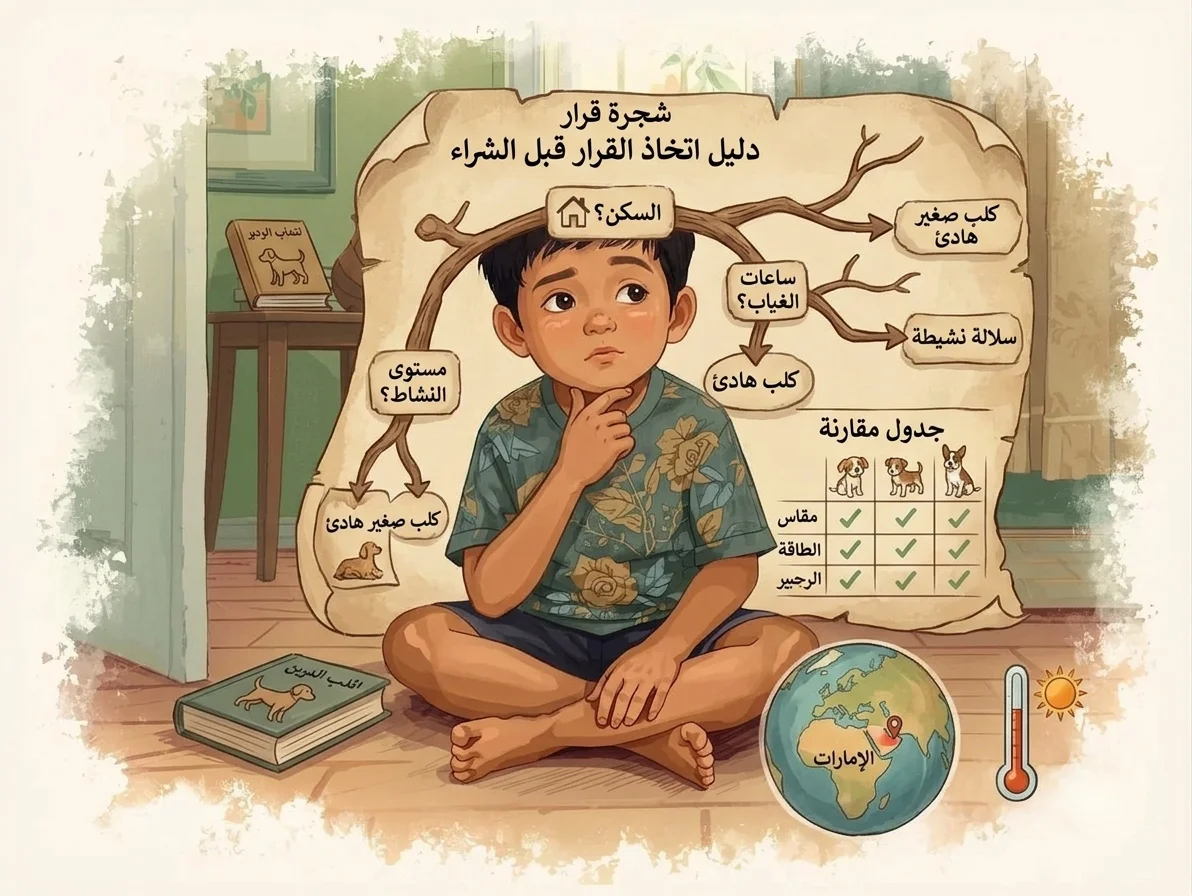
Dog Selection Decision Tree
Answer each question honestly and follow the suggested path. This simple decision tree will help you eliminate unsuitable options before comparing breeds or reserving a puppy.
Can You Set Aside Time Every Day for Walking, Training, and Interaction?
Yes: Continue to the next question.
No: Postpone getting a dog. Even a calm breed or a larger home cannot replace the daily care every dog requires.
Does Your Home and Housing Policy Allow Dogs?
Yes: Identify whether you live in an apartment or a villa, then continue.
No: Don’t purchase a dog until you have permission or move to dog-friendly accommodation.
What’s Your Real Activity Level During Most Days of the Week?
Quiet or Low Activity: Look for a dog with low to moderate exercise needs.
Moderately Active: Consider breeds with moderate energy levels and commit to daily walks and playtime.
Highly Active: Active breeds may be an excellent match—as long as you can provide both physical exercise and mental stimulation every day.
Is Everyone in Your Household Away for Long Hours?
Yes: Arrange reliable daytime care or consider adopting a calm adult dog after evaluating its personality and ability to adapt.
No: Continue by evaluating your family members and any other pets living in your home.
Do You Have Children or Other Pets?
Yes: Choose a dog with a balanced temperament, ask about its previous experiences, and introduce everyone gradually under supervision.
No: Base your decision on your experience, activity level, living space, and available budget.
Can You Commit to Training, Grooming, and Veterinary Costs?
Yes: You’re ready to begin comparing breeds and available puppies.
No: Consider a dog with lower care requirements or postpone ownership until your time and budget allow.
Your Decision Tree Results
Apartment with a Quiet Lifestyle
Look for an adaptable breed with a calm temperament and low to moderate energy level.
Family with Children
Focus on dogs that are friendly, patient, trainable, and comfortable around children with proper supervision.
Active Lifestyle
Choose a breed that can consistently match your daily activity level—not just your weekend routine.
First-Time Dog Owner
Look for a breed that is easy to train, predictable in temperament, and whose care requirements fit your lifestyle.
Frequent Travel or Long Working Hours
Don’t rely on breed alone. A reliable daily care plan is essential before bringing any dog home.
Choosing the right dog is one of the most important decisions you’ll make as a future dog owner. It’s not about finding the most beautiful puppy or the trendiest breed—it’s about finding a companion whose personality, energy level, care needs, and lifestyle requirements align with your own.
Take the time to evaluate your home, your schedule, your budget, and your family’s needs before making your decision. A thoughtful choice will make training easier, reduce behavioral challenges, and help create a happy, healthy relationship that lasts for many years.
At Puppies Hub, we believe every puppy deserves a loving home that’s prepared for the responsibility of dog ownership. By choosing carefully, you’re not only finding the right dog for your family—you’re giving that dog the best possible start to a lifetime of care, companionship, and happiness.